
Why is Glacier Ice Blue

Explore and Learn: Why is Glacier Ice Blue?
The Matanuska Glacier is an incredible feature of our natural environment located in central southern Alaska. The terminus is located in Glacier View, Alaska, right where the MICA Guides Base is located. On the MICA base, we have an incredible view of the white and blue ice that extends for 27 miles back into the valley.
Deep Blues
To better appreciate the deep blues, take a scenic helicopter flight over the ice or join our Helicopter Glacier Hike to explore up close. From any vantage point, the glacier’s blue hues stand out. Guests often ask, “What makes the glacier ice blue?” The Matanuska Glacier displays shades of cerulean, turquoise, and deep blue that captivate and inspire awe from both above and below. Book your adventure today and witness these breathtaking blues up close!
The Matanuska Glacier formed over many years as snow accumulated faster than it melted. This excess snow compacts into ice over time and becomes heavy enough to begin moving under gravity. The deepest layers begin to deform due to the weight of the snow and ice above them.
The Color Blue
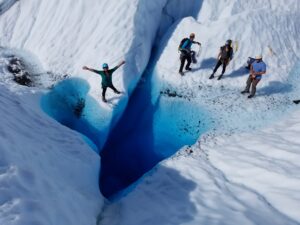
Since the ice in the glacier is so dense, it absorbs the long wavelengths that make up the red part of white light, and the short wavelengths that make up the blue light are transmitted and scattered. Basically, the glacier’s dense ice absorbs every color in the spectrum except blue. And so blue is the color we see.
Bluer ice means the light had to travel a longer path through the ice. It is a denser ice. This is why snow appears white, not blue. Light does not penetrate into snow far enough before it is scattered back to the observer. Also, there are more air bubbles in snow than in glacial ice, and these air bubbles scatter the light.
Glacial ice has a crystalline structure, which strongly scatters blue light. The ice has been strongly compacted for many years, so it has a different structure than the ice in your freezer. The glacier is made of more than just water and frozen snow; it also contains small pieces of rock and soil. These particles were accumulated as the glacier slowly moved through the valley, carving out the surrounding rock.
Glacier Views from a Helicopter
From the helicopter, you see the glacier’s path winding between the mountains, carved thousands of years ago. The bluest ice on the glacier appears as coarse-clear ice near the terminus (end) and the margins (sides). This ice contains no air bubbles and reflects the most blue light.
On overcast days, the ice appears a lot bluer than on sunny days. This is because there is less light to reflect from the upper ice layers, making the blue in the deeper layers more visible. Regardless of the sun’s intensity, a bird’s-eye view of the glacier in a helicopter is impossible to beat. It is the only way to observe all parts of the glacier and to discover new features, such as a newly formed glacier cave.
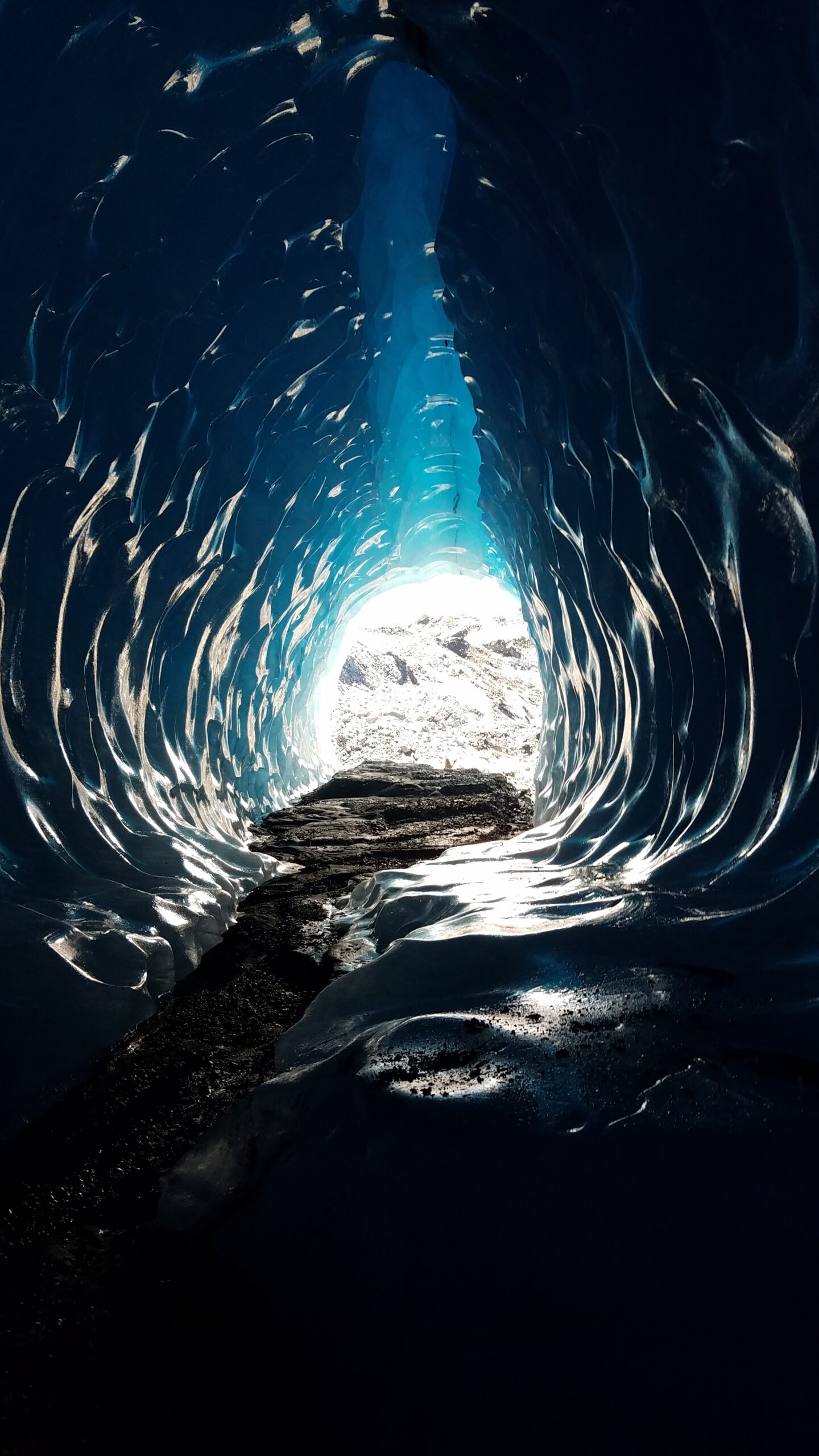
With our Ultimate Helicopter Adventure Tour, you will fly over the glacier and be dropped off with a guide in a remote location with unknown features. Glacier caves occur less frequently than other glacier features and are not as easy to access. Inside a glacier cave, the walls are dark blue. This is because there isn’t much light reaching the ice at that depth.
The only visible light is blue, reflected by the ice’s crystalline structure. Even if glacier caves are unavailable, you can still see dramatic blues by looking into a vacant moulin or a deep crevasse. Discover the wonders and colors of the Matanuska Glacier and experience a truly unique environment with MICA Guides.


